Tuesday, February 19, 2013

Reprints from Wizards continue . . OD&D this time

Yes, it is true, the Wizards over at Wizards of the Coast have found that there is a sound audience for reprints of their older (but still fine) roleplaying games.  They suckered me for the First Edition AD&D books, and I am on tap to get a set of the Second Edition AD&D books when they become available at Amazon.

But recently, thanks to info from John, I see that they are also republishing the original 1974 game (as in Original D&D or OD&D), as a set (all the books, and supplements):
  •  Volume 1: Men & Magic
  • Volume 2: Monsters & Treasure
  • Volume 3: Underworld & Wilderness Adventures
  • Supplement I: Greyhawk
  • Supplement II: Blackmoor
  • Supplement III: Eldritch Wizardry
  • Supplement IV: Gods, Demi-Gods & Heroes
It comes in what appears to be a nice brown box, with some foam cutouts for holding some polyhedral dice.


It isn't available yet through amazon, but keep an eye out for ISBN 978-0-7869-6465-9.

The posting from WOTC is here, and states that the release date is November 19, 2013.

Sunday, February 17, 2013

Jad the Pious - Old School Human Cleric

So, John is running an online (using Google Hangouts) old school RPG. He is using the Labyrinth Lord basic rules, which are quite similar to old Basic D&D.

My character in the game is a simple Human Cleric.  Since John is basing the game in the World of Greyhawk, I chose (no game effects, just background material) to be a cleric of St. Cuthbert of the Cudgel.  My avowed goal in the world is to smite evil.

I picture the character as having started out as a simple convert to the earthy teachings of the church of St. Cuthbert, and sometime while an acolyte my character had some run in with evil.  Probably while wandering the land, as a wide eyed youth, doing good deeds and ministering to the peasants of the central lands of the Flanaess.
A young version of Jad, wandering the lands.  The City of Greyhawk can be see in the background, no doubt he is checking on the doughty miners of the Flinty Hills.

After the eye opening experience, whatever it was, young Jad became dedicated to crusading across the land, and smiting evil as a crusading cleric.  His game stats are:

Jad the Pious.
3rd Level Cleric
Alignment: Lawful
STR 11
DEX  8
CON 10
INT 16
WIS 14
CHA 11

HP 18
AC 4 (chain mail, shield +1; DEX -1)

1 GP
3 SP

Magic Equipment
Shield of St. Philbert (+1 shield)
Potion of Animal Control
Vial of Oil of Slipperiness

Armor, Weapons
Sling, pouch full of bullets
Mace
Chainmail
Helmet

Adventuring Gear
Silver Holy Symbol of St. Cuthbert
Backpack
Hammer, Spikes (6)
Flint and Steel
Cooking knife
Candles (10)
Walking staff
25' rope
5 days Trail Rations
Waterskin
Lantern
5 flasks of oil (each for 4 hours of lantern light)
2 large sacks
2 small sacks
(sacks, initially, used to wrap equipment in backpack - later, for loot)

These days, as a traveling ruffian - avowed enemy of evil - Jad appears this way:
A more worldly and martial soul, Jad the Pious is now prepared for dealing justice against the forces of evil.

Thursday, February 7, 2013

Cold War Wargaming - Theremin Thursdays


It has been a while since I got to write about Gaming and Music. Today's topic is the Cold War. Specifically, the Soviet Union, and military actions in the cold war.

First, as a great library of song titles from the Cold War, I could do no better than the list already at the "In the 80s" website. They list just about everything, and give a brief description about what makes the song a Cold Wars song.

For my musical contribution today, however, I would like to point to a great little piece from the movie "The Hunt for Red October". The movie, by the way, is an excellent Cold War tale, based on the terrific novel by Tom Clancey. In brief it is about a Submarine Captain (Captain Marko Ramius, the Vilnius Schoolmaster) in the Soviet Navy that wants to defect, and the CIA analyst (hero Jack Ryan) who figures it out, and then has to convince the US/NATO side to allow the Soviet Captain the leeway to try it. Good stuff, very tense, and lots of background material about the political and military situation of the cold war. The fact that the Soviet Captain is played by Sean Connery.


The musical piece, from the soundtrack of the movie, is "The Hymn of the Red October", which is track 5 on the soundtrack.


The soundtrack is credited to Basil Poledouris (a favorite here at Gaming with Chuck HQ).  He was mentioned, prominently, in an earlier Theremin Thursdays article, for his fine work on the Conan the Barbarian movie.

The song "Hymn of the Red October" was made up for the movie, but it certainly sounds like a lot of Soviet martial music.  A lot of that music is very, very good - for military music.  Readers take notice: my admiration of the music, in no way extends to admiration for any of the horrors and atrocities committed during the Soviet era.  Much of the history of that state fascinates, but it also detests.

Another example of some fine (real world) Soviet era military music is the song "Invincible and Legendary - Glory to the Soviet Army" - here is a link to a version that I think is by the Red Army Choir.


For anyone interested, there is a LOT of music from the former Soviet Union, as well as pop music from both sides of the Iron Curtain, that detail the mood and feelings of the Cold War. One that I have to mention, because I was such a fan at the time, is from the German performer Gabriele Susanne Kerner, performed in the group called Nena.


There was a strong anti-military and anti-cold war, and even anti-NATO (and anti-US) movement in central Europe in the 80s. Politically one of the chief proponents was the Greens Party in West Germany (Sonstige Politische Vereinigung, Die Grünen).  They are even mentioned as setting the stage for the events in the cold war movie, "Red Dawn".  In that setting - with an environmentalist party appealing to the young, and also an anti war movement - songs like 99 luftballons were popular.  Here is a link to the song. (by the way, Nena did an English version of the song.  It doesn't work as well, in my opinion).


I recall at the time this came out, I was a college student at Christopher Newport College, in Newport News Virginia.  I was also a very active gamer at Campaign Headquarters in Hampton, Virginia (later moved to Newport News).  At the time, one of my chief interests was Cold War land actions.  This included a lot of the regional conflicts between super-power backed client states.  This included some of the brush wars in Africa; potential regional power conflicts, like India vs. Pakistan; and of course all the Middle East conflicts featuring Israel vs. a cast of thousands.  All of these had implications for the Cold War, and I think my fascination with the military and political situation was my response to the horrible situation of being 2 minutes from midnight on the Nuclear clock.  It was an interesting time.

As far as wargaming goes, I was playing with several different miniatures rule sets, mainly home brew and the games for Modern conflict from Wargames Research Group.  In 1988, however, Tabletop Games released Challenger II - and that became our favorite rules to play.  Looking back, they are overly fiddly and detailed, at least by the fashions of today, and they have a overly complex and long turn sequence.  But at the time we loved it.  All of us were fascinated with everything and anything about the military situation of the NATO and Warsaw Pact forces, so we were steeped deep in technical details, doctrine details, reports of regional conflicts, and specs on new equipment that was spotted and reported on in Jane's Defense Weekly.  Because of that, we THRIVED on the detail of the game.


The rules were backed up by a series of publications from Tabletop Games that dealt with specifications on all the equipment from all the world's armies, as well as new and speculative equipment descriptions.  These came out in Army List books, Digests, and Supplements.  I still have some of these, they are incredible sources of detailed information.  The Army List books have all sorts of ORBAT information on the different formations of the different branches and deployment configurations of the world's military organizations.  The Digests (which describe equipment) gave detailed shopping lists of all the pertinent systems that are included on each vehicle platform, as well as information on the Infantry and Aircraft weapon systems in use.


There were times when we would dip back into the WRG rules, or play around with Homebrew rules. Of particular note were the many Warlords games ran by Dan Conley, using early precursors to his popular Quickfire rules. The Warlords games were set some time after the 4th world war, with local Warlords in the nuclear blasted wasteland assembling small armies of WW2 and Modern equipment, and going to battle with each other over ruined cities, military bases, and other sites of potential salvage value.  Lots of fun.

Fast forward to today.  As I mentioned, the older rules are definitely not in the style that many gamers prefer today.  One set of rules that really captures a modern feel - meaning that it is not too detailed, not too chart heavy, has an innovative and fun way to play and control turn sequencing and C2 (command and control), but gives a rewarding game with good results in spite of detail being abstracted away - is the set of rules called Cold War Commander.  They are by Peter Jones, and published by his company Specialist Military Publishing.

At the time of my writing this, I think that SMP are sold out of physical copies of the book, but you can order a PDF from them, or order a physical copy printed by Lulu. The rules are great, and are a real pleasure to play, and they are also self contained - they include everything you need to know in order to play conflicts from the 1950s on up through tomorrow - with loads and loads of army lists.  All of the regional conflicts that we watched and were interested in during the 60s, 70s, 80s, etc are all covered, as well as extensive coverage of all the "potential" participants in a WWIII scenario that could have happened during the Cold War.  A nice review of the rules, and contents, is on Youtube by TheTableTopGamer - a nice 19 year old wargamer from the UK.

I have several miniature armies for this era, that are usable with the Cold War Commander rules.  I try to collect them in pairs, so I have some Israeli and generic Arabs (that could be Syrians, Egyptians, etc).  For those conflicts I really favor 1967 and 1973.  I have some second and third tier NATO equipment, and an equivalent set of Warsaw Pact equipment.  This allows me to do fun things like Poland vs. Belgium in 1989, and so on.

The key feature of the game is that there is a dice and decision driven Command and Control structure.  Your army will feature a hierarchy of commanders of different elements, and each has a command value, representing a number from 2 to 12.  A very good commander would be rated a 9 or 10.  Players will identify a commander, roll 2d6, and if successful be able to issue orders to units under control of that commander.  Orders are basically move, or shoot, or move AND shoot. If you pass your test, then after your order is carried out, you can roll to do it again, but with a negative dice modifier.  When you first miss your dice test, then that commander is over for the turn.

There is a lot more to the rules, but for me that is the heart of the game.  It is very similar to the sister publications from SMP - Blitzkrieg Commander (covering WW2), and Future War Commander (covering a wide variety of Science Fiction settings).  The command and control rules in all of these are very similar to, and are rumored to be borrowed from (by Peter Jones, and with permission and blessing) the Warmaster series of Fantasy and Historical (Ancients and Medievals) rules by Rick Priestley.


Some of Rick's more recent efforts (such as Blackpowder for battles from 1700-1900; and others, such as Hail Caesar also from Warlord Games) have a modified version of the same structure.  In this modern version, you make one dice toss for your commander, and depending on how well it is passed, that determines (ahead of time) how many actions the command will have.  Very useful.  Takes out some of the guessworks,

So, all told, this is a very nice family of wargames.  In the words of the Vilnius Schoolmaster (Captain Marko Ramius), "Shplendid".


Wednesday, February 6, 2013

Comparison of Ticket To Ride variants

The following is an excerpt of a letter I wrote to a friend comparing the various Ticket to Ride variants.  The official ones, anyway.  I thought other people would find it useful.

Ok, here is the rundown. The dice add on, as I said, makes for a different, faster, but still enjoyable game. We like it a lot, but it does feel different from regular TTR.

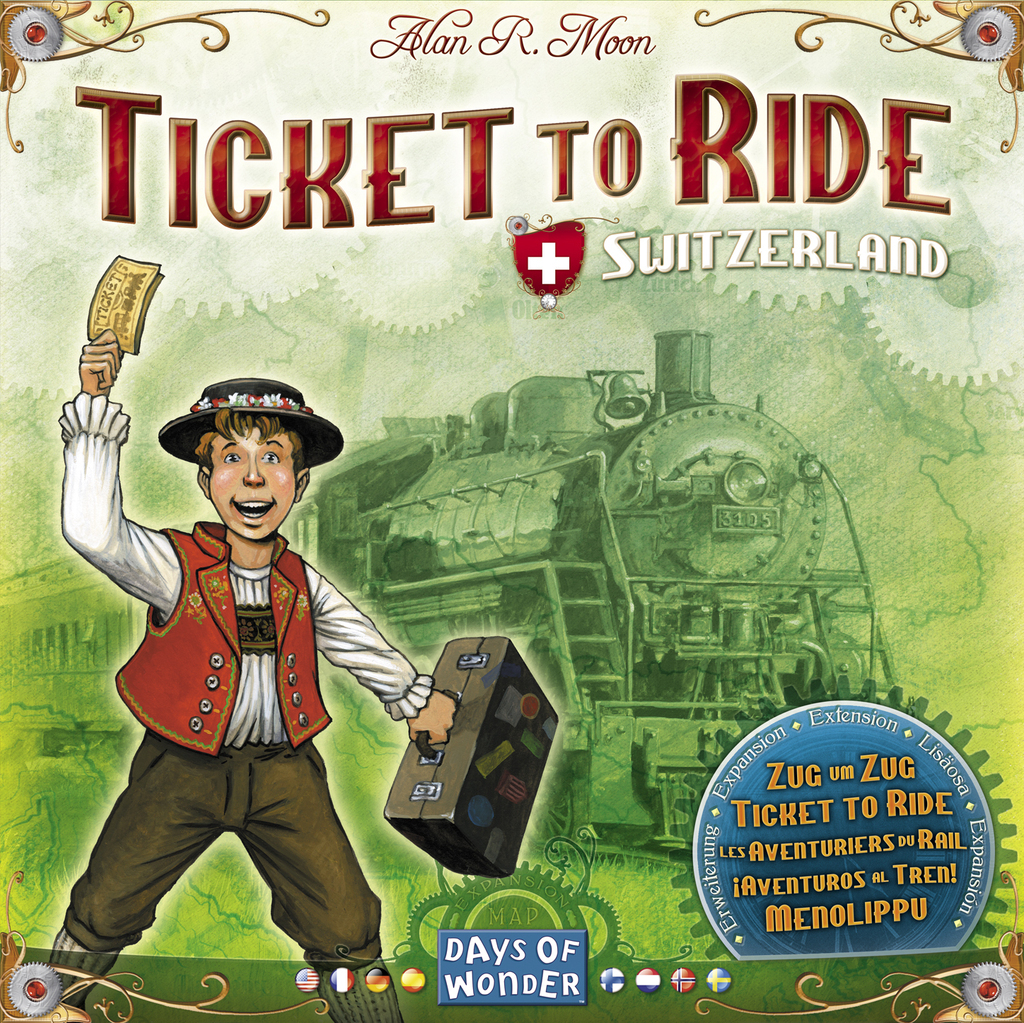
Both the Nordic Countries and the Switzerland alternative are loads of fun, especially for small groups. They are both designed for only 2 or 3 players. Both incorporate rules for tunnels, and Nordic Countries has rules for Ferries. Very simple rule changes, but fun. Tunnels are specially marked train routes that may require extra cards to build them. It is random (you draw three extra cards every time you build a tunnel; if any match the color you are building, it means you need an extra card). The effect on play is that it is a little risky to build a tunnel route, unless you have collected a few extra cards of that color. We find it to be a nice rule addition. Ferries are routes that require either one or two of your cards to be locomotives. Also a fun addition. The maps themselves also have differences.

In Nordic Countries, the map has lots of short routes in the southwest, and lots of long routes in the north east. It means that depending on the tickets you select, your strategy will be different. In Switzerland, almost all of the tickets are easy, and short, and you tend to complete a LOT of tickets. Scores can run high in Switzerland. Both are lots of fun and we (Anita, my wife, and Heidi, our daughter) like them. Nordic Countries also has a Christmas-y feel to he artwork, so we often pull it out to play over Christmas break.

There is a Europe version, that is great for family play. He reason is that it allows you to build a Station if you like, on a city. It has the effect of allowing you to use a route that was claimed by another player, so being cut off is not as disastrous as in the other versions of the game. It really is only important for larger games, or games where one or more of the players are somewhat aggressive. The tickets for Europe are much more evenly spread out than the base game. Europe also incorporates tunnels and ferries.

There is a Legendary Asia version, that features a map stretching from the Ukraine to Japan, and from Siberia to India. It is a lovely map, and the tickets are the most spread out and even of all the variants. It features Ferries, and Mountain Passes. The latter require you to discard a train piece every time you build one. Those discarded pieces are worth 2 points each at the end of each turn, and they have the effect on the game of making the many short routes in the higher population areas of the map as being worth a decent amount more than the regular 2 or 4 points they would be in other versions. It is a very fun version and has a great feel to it, but less player interaction (like racing to complete a route) because of how evenly placed the tickets are.

There is a Team Asia version (the map focuses on China) that allows you to play as teams, possibly including a Sixth player. You can also play without teams, but the team rules look interesting. Each player has their own train cards, plus train cards that belong to the team. Team mates are not allowed to share info about what they plan to do, and can't show each other their non team cards. Looks interesting, but we haven't played the team version.

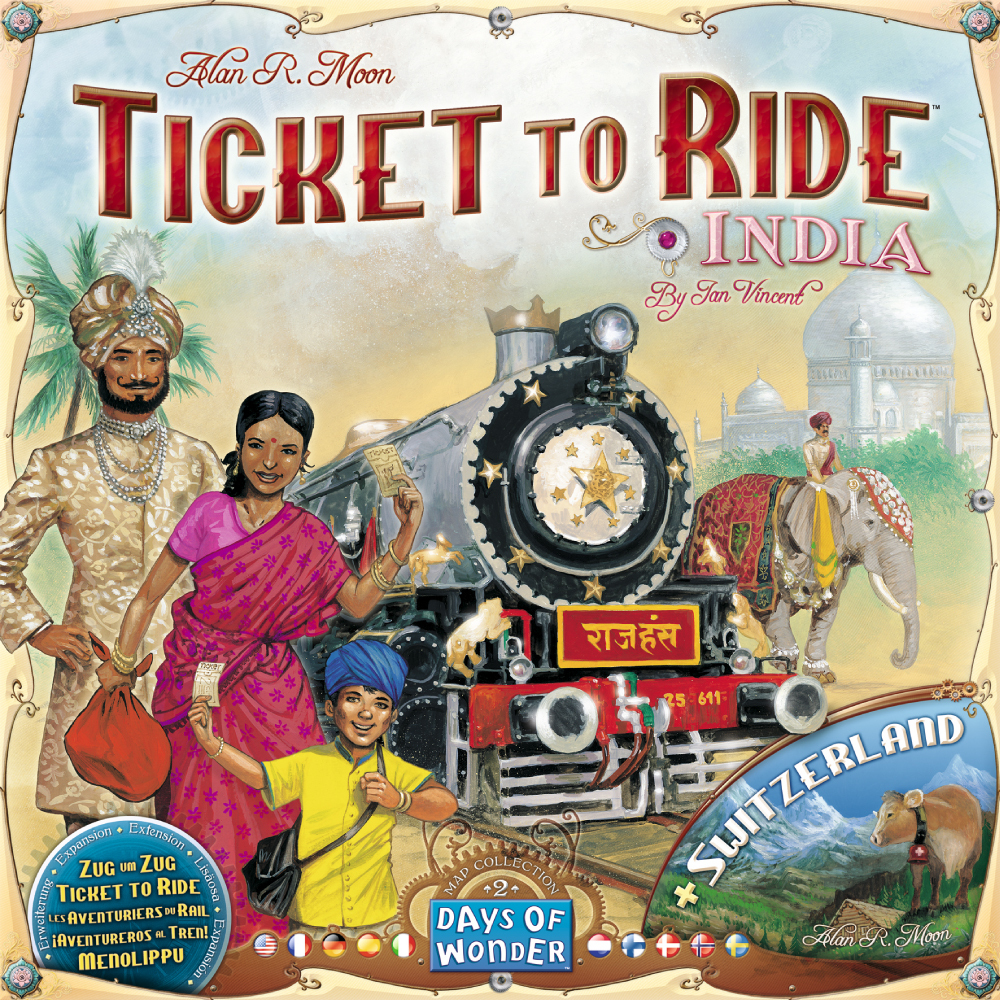
There is an India version that just is a different board, but one that is a lot of fun to play. It gives bonus points for completing tickets using two or more different paths. Very interesting feel, and a bit more competitive than other versions.

There is a Germany version called Märklin. Märklin is a German manufacturer of model trains, and they sponsored this one. Every train card has a picture of a different model train car on it of the right color. The map has Passenger markers on it at the beginning of the game, and a player may choose to collect all the markers on a train route instead of a regular play. Knowing when and if to do that adds another level of decision making to the game. I love this version, but Anita and Heidi have said it is the hardest to play, and quite competitive. I love the cards because I love railroading history, so maybe that clouds my judgement!

There is a Heart of Africa version, that has special cards allowing you to multiply your points for jungle, mountain, or desert train routes. I have not played it, but it looks beautiful (the map and the cards).

These are the official map board variants. Switzerland and India come packaged together. Legendary Asia and Team Asia come packaged together. Africa comes alone in a box. Europe and Märklin and Nordic Countries all come packaged alone, and they each include basic pieces (plastic trains and train cards). The others only have rules and ticket cards, so require a basic set to play.

Other than the variant map boards, there are four other add ons. First, already mentioned, are the Dice, which work with any variant, but building the special 9-car ferry in Nordic Countries would be very hard using the dice system.

Another (Excellent) add on is the 1910 box. It has very nice full sized train and ticket cards for the North America game (I really don't like the little cards, they are fiddly and hard to shuffle). It also includes a number of variant ticket cards hat each give the basic game a very different feel. For a small add on it really improves the game experience (better cards) and gives lots of different game play alternatives.

Europe has a similar boxed add on called 1912. I also adds extra tickets for Europe (the Europe base game comes with larger cards, they learned their lesson after the first set), and another variant. This is the Warehouse, which is a way to collect extra cards that come in handy.

There is also the Alvin and Dexter add on. Alvin the alien and Dexter the dinosaur are plastic pieces that move around and block cities from being developed. Very cute, but it was not a favorite at our house.

Finally there is the Halloween add on. It is a full set of plastic trains in gray, witH plastic pumpkins in them. Very cute, and a nice add on set of pieces, but no real changes to he rules.

Monday, January 28, 2013

19th Century Imaginations - Rebasing ACW figures

I got to spend some time over the weekend prepping my man cave for an upcoming project.  A little more effort will be required, but it is close.  I have a trip later this week, and I'll be gone most of the weekend, but in two weeks, there should be some project made.

The specific work will be to start re-basing my sizable collection of ACW figures.  I am going to base them on 40x40mm bases, with three figures to a base.  This will allow me to play most of the rulesets I care about for ACW, including home brew, Neil Thomas, Glint of Bayonets, Fire and Fury, Black Powder, Rank & File, and others.

One of the interesting side effects of this rebasing effort is that I will also be able to start doing some Imagi-Nation gaming.  My fictional company of Furstenberg, in the equally fictional region of Balkania, has blue coats and blue kepis making up their infantry uniform, so the US troops will work perfectly.  Against them, is an uprising of a variety of desert and mountain tribesmen (the ethnic Urbs of the Karzstan Mountains), and these are supported by regular infantry, wearing an 1880s Egyptian uniform (the Trans-Turkylvanians).

Previous posts on Balkania, especially Furstenberg, are here -

See here for details on the Furstenberg uniform -

See here for details on the organization of the Furstenberg army - 

The Balkanian nation of Furstenberg is mapped here - 
http://chuckgame.blogspot.com/2009/10/furstenberg-mapping-project.html
It should be a satisfying project, and hopefully one that will give me some fun modeling time, and also some fun solo-wargaming time.

Wednesday, January 16, 2013

Units, Environment, Movement, Weapons - City States of Aquaria


So, I have been pretty busy since I first got the idea, and started sketching out particulars, for the "City States of Aquaria" game.  Here is a rundown of my progress.  I even got some materials to make playtest counters and a map, but then things got REALLY busy in my real life, so it is creeping along.

Environment - The environment of the game is a science fiction setting - the battles that take place between various techno-feudal city states on a water planet.  These city states have large domed underwater cities, with underwater industry, robo-farming, manufacturing and resource extraction.  High speed movement between these domed cities is by tube train, and there are all manner of craft designed to navigate the depths below, surface, and atmosphere above the shallow seas of the world.  Man has even adapted to living and moving around underwater pretty easily.

Klaus Bürgle: City under the Sea*

In wargaming terms, this means that the action will take place on a hex map showing the sub-aqua terrain.  In the game, within a hex, units can be at 5 different heights.  Ocean floor, low ocean, mid ocean, high ocean, and Surface.  Underwater topography (hills, plateaus) will be in one of three different levels, sort of like the "wedding cake" hills of table top miniature gaming, or of the older BattleTech maps.  Each level (low, mid, high) will correspond to one of the ocean levels.

Units will be able to move about in the water, although some units will be tied to either the bottom, or the surface.

Movement - Each type of unit will have a basic movement allowance.  This is, generally speaking, expended to move through the hexes on the map.  Units that can change levels on their own (i.e. - not those tied to the ocean floor, or to the surface) can also expend points of their movement allowance to change levels.  In general, a movement point is spent to move one hex, or to change one level.  The moving unit must move laterally (on it's own level) one hex, before changing levels, and must make a lateral move between each level change.  The exception to this is that if the unit ONLY wants to change levels, then it can expend it's entire movement allowance to go up or down 1 level, while remaining in the same hex.

Units - As mentioned in the earlier post the types of units are basically four categories.  Those are:
  1. Floor Units, which move around mainly on the ocean floor.  This includes Infantry, Armor, and Artillery.
  2. Ocean Craft, which includes different sized man-made submersible craft, up to and including massive multi-weapon system craft.  Units include Aqua-Jets (small two man fighters), Stingrays, Aqua-Cruisers, Leviathans and Leviathan-Hunters.
  3. Biologicals, which includes various animal types that have been modified for combat, and are controlled and directed by a human telepath.  These include the semi-intelligent sea mammals of Aquaria, the Cetas, Orcas, and Megas.  Also, the enormous monsters from the depths, the Behemoth, the Kraken, and the Gargantua.
  4. Surface Units, which include large surface units, and a variety of atmospheric fast movers.  Units include Surface Control Ships, Attack Hovers, and Assault Hovers.
Weapons - Most of the Ocean Craft (except for the Aqua-Jets and the Stingrays) mount multiple weapons, the choice of which (depending on the scenario) will be up to the player to choose.  Most weapons will have a chance to destroy just about any unit from one shot (if it is successful), but the larger monstrous biologicals (Behemoth, Kraken, and Gargantua), as well as the larger ocean craft (Leviathans and Leviathan Hunters) have a much harder time of being destroyed from a single hit (although it is possible, just very rare).  Instead, hits against them destroy capabilities (weapon mounts).

I have basic stats on almost all of these units, and I'll try to get it posted for next week's Wargaming Wednesdays, here at Gaming with Chuck.


This is some inspirational video.  There is so much cool stuff going on in this video, I just gotta watch it over and over.  The "bad guy" underwater city, at about 15 minutes in is very inspirational.  Also, Hydronic Rockets? Awesome!


* Painted 1964 by German futurist Klaus Bürgle for "Das Neue Universum". This and other paintings by Bürgle can be seen on www.retro-futurismus.de

Thursday, January 3, 2013

Dispatches from the Monstery

Previously unknown to all but a few, the secret headquarters of "Gaming with Chuck" is located in a remote monastery.  There, the wizened dwarf-like staff of writers and artists toil away in complete darkness, living only on a tea made from the fallen scales of mountain lizards, and get their only rest by balancing on sharpened pieces of shale, while reciting "Little Wars" and "The Complete Hoyle".  A single rare photo of the HQ exists.


Currently the staff is scribbling away on City States of Aquaria, as well as additional information for Traveller Tuesdays.  The next installment of Theremin Thursdays should be interesting as well.  In the meantime, we hope all who read this had a great Christmas season, as well as a hopeful and rejuvenating celebration to kick off the New Year.  If anyone has mountain lizard tea recipes, please forward them.