Monday, March 11, 2013

19th Century Imaginations - Rumpwhistle (2 - military of the Confederacy)

So, the Confederated Cantons of Rumpwhistle, as the country is known in the later half of the 19th century, has its army organized in two broad parts.  Rumpwhistle also as a small navy, to patrol its coast along the shores of the inland sea, Lake Balkania, but that isn't addressed here.

Rumpwhistle Infantry
The first segment of the army is the National Army of Rumpwhistle.  These are troops that are organized to work together, and take their direction from Premier of the Landhouse, who is supposedly the head of the army, but in reality often just appoints generals from the capitol building at Ramshorn.  These troops are funded by Confederacy money, which is often of poor amounts and late in arriving, so because of that the National Army units are often of poorer quality - in terms of both equipment and morale - compared to the second part of the army.  Due to the long heritage of the country as once being a Monarchy (the Earldom of Rumpwhistle), there is a long and proud heritage of sons of the nobility serving in the Army as senior officers.  That tradition, in the late 19th century, still encourages sons of families with money or status, to attend to their ancient military obligations.  Because of this, the officers of the National Army are usually of a high status, and often rather idealistic.

The second segment of the army are the Canton Units.  In reality each of the 13 cantons of Rumpwhistle has their own individual army, but these are rather small, and highly variable in size.  However, there is, in the Treaty of Confederation, terms that require the Cantons to submit units for the common defense of the nation at large, and to support each other in case of internal or external threat.

There are 9 cantons and 4 independent cities that are treated as cantons - they have seats in the Landhouse, and provide units to the army.  These are listed here.
  • Sutliff - Coal mining country.  Also known for their musicians.  Units frequently accompanied by extra pipers and drummers.
  • Nikovena - Cold mountain country, with thin soil.  The only real economy is sheep herding, and the land is too rocky for many horses.  No cavalry units from Nikovena.  Capitol city is Papaschlemo, and the Canton is always struggling with the local Bosniak population.
  • Gawith - Strong tradition of distilling spirits.  Located along the mountains, Gawith is the home of the Hoggarth Rebels - formerly Drover highlanders aligned to Furstenberg, but during the Cattle Raid wars of the last century, broke off and moved to the Rumpwhistle (Gawith) side of the border.
  • Pease - The trade city of Meridda Hill is in Pease, and it is home to the best armories and foundries in Rumpwhistle.  Pease Artillery units are legendary, at least amongst the Canton armed forces.
  • Fribourg - Hill country.  Home to a very contentious local population.  Given to strong drink, poetry, and reactionary political movements.  They make good infantrymen.  The chief town of Mac Baren is home to the famous Red Guard - volunteers during the civil wars, and rabble rousers the rest of the time.
  • Cornell - Location of the port city, Diehl.  Many foreigners enlist here, making Cornell regiments the most "exotic" in make up of all the Canton forces.
  • Stanwell - Farm country, home to a good many horse communities.  Stanwell cavalry is the best in the Confederacy.
  • Dunhill - Coal miners, again.  These fellows are strong in a fight, but they never went anywhere fast.
  • Peterson - Sheep country.  High population, but it is kept mainly in the walled towns, with the countryside given over entirely to the Sheep trade.  The capital of the Confederated Cantons is here, the city of Ramshorn.
It is interesting to note that Ramshorn is not considered one of the independent cities, but that was due to the Treaty of Confederation thinking that it was important, and powerful, enough without having its own electors for the position of Premier, or independent representatives to the Landhouse.

The four independent cities that DO have Canton status are:
  • Eriksen - City at the junction of Sutliff, Cornell and Fribourg.  Lots of class conflict, between the wealthy traders of Cornell, the miners of Sutliff, and the "salt of the earth" people of Fribourg.
  • Wessex - City is in between Stanwell and Peterson.  Wessex stock markets are known for their horses of Stanwell, sheep of Peterson, and sharks of Wessex.
  • Grabow - Between Dunhill and Gawith.  Grabow University is the elite seat of learning for Rumpwhistle.
  • Long - Bordering both Nikovena and Pease.  Marksmanship tradition going back to the middle ages, when Pease Longbowmen were highly sought after mercenaries.
Regular Infantry on the left, Canton Infantry on the right

The last significant focus of military strength in Rumpwhistle isn't a part of the regular armed forces.  That focus is on the various irregular units that will often (but not always) align themselves with the Rumpwhistle forces (either the Confederacy army or the Cantonate forces).   These groups include the following:
  • Urbik Hill Tribes - the ethnic Urbs are a fierce hill people, and will often come together, many different smaller tribes and villages, under a charismatic warlord, to either fight for or against the Rumpwhistle forces, depending on the way the wind is blowing.  Occasionally the Urbs will get caught up into the Pan-Urbik league, which stretches Urbik territory over the nations of Rumpwhistle, Vulgaria, and Furstenberg.  Occasionally Urb tribes will have cavalry, either mounted on horseback, or if they have ties to the tribes from the arid Simian Plains of Furstenberg, they may have camel mounted units.  Urbs are renowned for their deadly accurate rifle fire, and are frequently armed with jezzail long rifles.
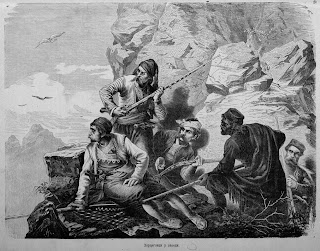
    Urb Hill Tribesmen
  • Bosniaks - these are wild men of the hills in and around Nikovena.  The original Bosni-Balkanian people of the region have mostly, over the centuries, been integrated with the various European, Asian and Semitic nations that have invaded or colonized, but these represent pure Bosni-Balkanians.  They are sworn enemies of the Urbs, but also of the Rumpwhistle nation.  It is rare that a month goes by without a Bosniak raid on Papaschlemo (the capitol city of the Canton of Nikovena).  It is possible, from time to time, that Bosniak units (occasionally irregular foot scouts, but more likely to be rifle and spear armed light cavalry) will join a Rumpwhistle military column.
    Bosni-Balkanians
  • Wagon People - there is a culture of nomadic peoples that live in and around the hills of the Fribourg Canton, that are best described as either tinkers or gypsies.  They move around, in large extended family-clans, using horse drawn wagons.  These wagons serve to move the family goods (each adult individual or couple in the family-clan will have one or more wagons), and are peopled either by family members, or by the serfs that they capture in their raids and clan wars.  Again, the wagon people will occasionally join a Rumpwhistle operation, but frequently when it is against either Urbs or Bosniaks.  The fighting style of the Wagon People is to form a defensive "fort" by placing their wagons into a laager formation, and firing out against the enemy.
    Defensive Laager of the Wagon People


So the Confederacy army is divided up into three Corps, but they have different duties.  The first corps, Home Corps, is almost always located at Ramshorn, to provide home guard units, ceremonial duties, and manning the headquarters of the army, Fort Boxtinder. The second corps, also called the Spirit Corps, is used for training and recruiting.  The various units in the Sprit Corps (really it is at division, or lower, strength) are almost all under manned, yet they have a full complement of Officer and support structure.  These units are spread out among the various Cantonate military forces, and provide a reach-back to the Confederacy from those military forces.  The third corps, also known as the Expedition Corps, is kept up at full strength, and is the "field army" of the Confederacy, kept at a high level of readiness.  The other parts of the Confederacy army are theoretically available for use, in case of major operations, but it would take some time to mobilize and equip the units.  The Expedition Corps is the first option for military actions in or around Rumpwhistle.

Cavalry of the Expedition Corps


Expedition Corps (III Corps, Rumpwhistle Confederacy Army)

6th Division
  6 regiments of infantry (each 2 battalions)
  1 regiment of grenadiers (3 battalions of grenadiers)
  1 battalion of jaegers
  1 cavalry regiment
  1 artillery regiment

8th Division
  4 regiments of infantry
  2 regiment of grenadiers
  2 cavalry regiment
  1 artillery regiment

12th Division
  6 regiments of infantry (each 2 battalions)
  2 battalion of jaegers
  2 artillery regiment

Terrapin Division
  4 regiments of infantry
  2 regiment of grenadiers
  2 battalion of jaegers
  1 cavalry regiment
  2 artillery regiment
 The next article in this series will cover the Canton troops.


Saturday, March 9, 2013

19th Century Imaginations - Rumpwhistle (1 - history)

So, in spite of the danger from Vulgaria, when the Twenty Three Weeks War started because of instigation by university students in Furstenberg it wasn't against the Vulgarian Empire, it was instead against the Confederated Cantons of Rumpwhistle.  Since I am prepping my wargaming armies to be able to fight out the major engagements that were part of this little brush war, I thought it would be prudent to detail some of the background history of Rumpwhistle, and also her military structure.

During the later Middle Ages, due to the vagaries of glebe law under the canonical rule of the Balkanian Orthodox church, a large parcel of land passed from a priest, to his third son.  At the same time, the son was forced into a rather uncomfortable arrangement with the daughter of a Vulgarian duchess.  The father of the bride to be, rather ashamed at having an illegitimate son of a priest as a son-in-law, rather took things into his own hands, and through bribes of the local elector, had the lad dubbed Earl of Rumpwhistle.  At the time, the Rumpwhistle lands consisted of a small sheep farm, and a coal seam that had never delivered.  Immediately following the wedding, however, the church lands eschewed to the new Earl, making him a rather large and prominent landowner, and all of a sudden, the envy of his Balkanian neighbors.

Over the next three hundred years, war upon war hardened the little kingdom of sheep herders and coal miners into a political nut that was hard to crack.  The line of Earls sure had its fair share of loonies (some would say more than its fair share), but the various barons and mayors under the Earls did a pretty good job of keeping the various baronies and royal cities in line.  Several wars, especially, in the 16th and 17th century, fought over church rights, succession to the Rumpwhistle Throne, the ongoing question of the Ethnic Urbs (noisome people who live in the Carfathian Mountains, and the Karzstan Mountains, between Rumpwhistle and her southern neighbor, the Margravate of Furstenberg) and finally the Vainglorious Revolution fought in the 1680s.

That last war, was an internal civil war, between the noble families (many of whom were herd land owners, but some were also urban traders in coal oil and root vegetables) and the democratic body known as the Landhouse.  It seemed that the people at large (stirred up by religious zealots and free-land herders - their motto was "sheep are sheep") wanted a say into the running of court.  Especially in the restrictions on use of powdered wigs, silk stockings, lace covered cuffs, and high heeled shoes for men.  The nobles were having none of it.  So a civil war broke out, between the ancien regime of the nobles on one hand (the Earl and his followers were brought into this faction), and the Landhouse leaders, religious rabble, and populists on the other side.  The war raged for a couple of months in late 1682, on into the spring and summer of 1683, but as these things often do, it petered out once the fall skittles season opened up again.  The nobles, eager to get back to their skittle greens, hastily signed a peace with the Landhouse, and even forced the Earl to ratify the Treaty of Confederation, signed in the golden Dome of Man, the great house in the city of Ramshorn where the Landhouse meets.

The Treaty of Confederation raised the various baronies and independent cities into Cantons.  Each having an equal vote for the two year office of Premier of the Landhouse, and each providing sitting Consuls for the Landhouse.  The treaty allows the method of election, both of Electors for the Premier and also of Consuls, up to the Cantons.  And in all internal matters the Cantons have free reign, save a common currency, and common observance of the practices of the Reformed church of Balkania, Nikovena Synod.  The matters relating to the currency, as well as to the organization of the common Confederacy Army, which the cantons all contribute funds and men towards, are handled from Ramshorn at the Dome of Man.

In the early 18th century, when Northern Furstenberg was embroiled in the War of Pumpkin-King Succession, the new Cantons of the Confederacy of Rumpwhistle were too involved in their own natal state matters to get involved, other than some of the Cantons sending volunteer regiments to assist this side or that side (either the Grand Duchy of Poppenheim or the Principality of Bombastia).

In the early 19th century, the Cantons provided troops to various factions to the waging of the Napoleonic Wars in Balkania.  By the middle of the century, economic pressure had pushed Furstenberg and Rumpwhistle into competition again, and a military buildup ensued on both sides of the border.


Friday, March 8, 2013

19th Century Imaginations - the Twenty Three Weeks War

So, having begun the basing of my old 28mm ACW figures, re-purposed for a Balkanian campaign, I figured it was time to share my fevered vision of a history of a small brush war in Balkania.This is the history of the 23 Weeks War, a war fought between the Autumn of 1871 and the Spring of 1872.  It involved the forces of Furstenberg (a small enlightened aristocracy) and Rumpwhistle (a small state of confederated cantons), fighting with each other over (nominally) the rights of the Ethnic Urbs (local ethnic tribes living in the mountains straddling the border between the two nations).

The problems, as they almost always do, began with disgruntled students. The Protectorate of Graatz, having been granted to the Margravate of Furstenberg as part of the Edict of Boomplatz peace (see history of Furstenberg), had grown and matured in the two centuries under Furstenberg protection. A university on the lovely Dukon River (see map of Furstenberg) had grown up, the University of Graatz, located in the city of Alf-Dukon. The students there, always looking for a way out of their academic duties, sensed weakness following the short War of Disdain (1868-69) between the Confederated Cantons of Rumpwhistle, and the revolting Karzstan Mountain Urbs. The Urbs were subjugated, but there was concern on the Furstenberg side of the border at Rumpwhistle mobilization.

In the late summer of 1871, the students of Graatz University decided that they would not have a regular academic year. So once school started, they began rioting, demonstrating, publishing pamphlets, and protesting the treatment of the Ethnic Urbs, and the heavy handed action by Rumpwhistle in the Karzstan Mountains. This came to a head in September of 1871, when the visiting Prince of the Rumpwhistle Throne (a purely decorative figurehead position, ever since the Confederated Cantons established their independence in the early 18th century) was assassinated on a diplomatic visit to Alf-Dukon. Whether it was by an Urb mountain sharpshooter, or by an instigating student, war was quickly declared by both sides (the Rumpwhistle Confederation in order to save face, and the Furstenbergers in order to not be outdone).

The fight took place mostly in the rough country of the northern slopes of the Karzstan Mountains, on the Rumpwhistle side of the border (in the Rumpwhistle canton of Nikovena). This was a war for infantry, mainly, and involved a lot of local units on both sides, including irregulars and sharpshooters.
Painting showing the battle of Papaschlemo, in Nikovena, from 1542 - this is indicative of the terrain fought over in the 23 Weeks War

For the fight, I am working on a modified set of ACW rules (the Rumpwhistle troops are amazingly close to Confederates, and the Furstenberg Infantry are amazingly similar to US regular army).  I am also planning on an article concerning the Rumpwhistle forces, and the Furstenberg forces, involve din the war.  On the Furstenberg side, it was mostly elements of the Second Army, Fourth Corps, but some interesting local color was involved.

Thursday, February 28, 2013

Wargame Wednesdays - GEV map, The Delta

I have been working on some OGRE/GEV scenarios.  Playing around with a mini campaign, that will involve multiple maps.  I have completed the first one and wanted to post it.  Please leave suggestions.  This map is called THE DELTA, and features a natural resource area (Oil rigs in a river delta).


Friday, February 22, 2013

Theremin Thursdays - Gaming in the Viking Age


While there are possibly a few different pieces of music that would be appropriate for this theme, one of my favorites is Steve McDonald's "Sons of Somerled".


This is telling the story of Somerled, who was a ruler of the Kingdom of the Isles (gaining parts, through marriage and conquest, until he ruled everything from the Island of Lewis to the Isle of Man) in the 12th century.  His name (Somerled, or Somairle) is from a Norse word meaning "Summer Traveler".  A Summer Traveler, to the Norse, was one who did his "business trips" in the summer months - a Viking.


On one of his other albums, Steve McDonald has another song, called Seawulf.  Here are the lyrics (another great song).
In the long-boats Seawulf came,
Crying out the War god's name,
Highlander, raise your warning fire,
Seawulf's on his way,
To feed the battle-crow's desire today.

Isle of Man and Isle Tiree,
Faced Odin's giants of Valkyre,
Gaining control of Argyle,
The western highlands too,
Somerled has delivered us from you;

Seawulf will rise

Oh, oh, oh, oh, ooh
Oh, oh, oh, oh, ooh

Viking child, oh Viking child, oh Viking child,
Who will tame the wolf behind your smile...
Viking child

Viking child, so free and so wild,
Tell me why do you roam,
Battle on, the Seawulf in search of home. 


(A lot of oh-oh's in the middle, but a good song nevertheless).  Again, from the same period (late dark ages, during the times when men of the north were raiding and setting up kingdoms in the coastal regions of Scotland, the Isles, England and Ireland).  


As far as gaming in this time period goes, there are a lot of different "collection" games of medieval and dark ages battles (based on the old SPI idea of a Quad wargame - one set of core rules, with a number of different scenarios, each with a different map and counters, and different special rules).  But there are also a fair number of games that deal with the Norse world in general, and Viking ideas and ideals in particular.


One that has fantastic artwork and production values, but the theme could have been just about anything related to economic competition, the game Vikings is one I own and enjoy playing.  Sadly, there is little or nothing involving conquest, raids, or combat in this game.  It is a Michael Kiesling game, and (as I mentioned already) one I find very enjoyable to play.


Another game about this time period, but one more in line with what the Vikings themselves thought about the world, and their own destiny, is the old TSR minigame, Saga.  I have a copy of this game, and although I haven't played it in years, I used to play it quite a lot, in high school with my two brothers, and later on with gaming buddies.  A great game - you begin as a hero, and have to travel the Norse world, dealing with creatures and foes (both mortal and from myth), slay monsters and dragons, fight trolls and berserkers, gain a named (magic) sword, and construct a Saga about yourself.  


Great game.  Text from the box, reads like this -

"Saga minigame recreates a mythical time period occuring sometime after the fall of Rome - the age of heroes and vikings! Each player takes a heroic figure and attempts to perform deeds that will generate enough glory to ensure that the hero's memory will live in the sagas composed after his or her death. 
To gain glory, the heros slay monsters, accumulate treasure hoards, recruit lesser heros ("jarls", or earls) as their companions, and establish kingdoms. The hero who gains the most glory is the one whose fame will live on in the sagas, while the others are doomed to be forgotten by posterity. Each player must be decisive and alert to grasp chances and avoid having other heroes gain glory at his or her expense."

Those were the days.  At that time (around 1980) TSR was riding high on HUGE success from AD&D, and they wanted to get into the hot Sci-Fi/Fantasy microgame market (made successful by companies like Metagaming and Task Force Games).

Two other microgames come to mind in this theme.  First is the great game from Metagaming, Fury of the Norsemen.  This was one of their historical micros, and although it isn't a phenomenal design, it was pretty solid for its size, and I really enjoyed playing it.  The cover art, and the rulebook art, was atrocious.  It was a bad pastiche of Frank Frazetta barbarian artwork (which I DO enjoy, but which is NOT historical).  The counter art was, on the other hand, really good.  The map, well, it was a map.  Here is a picture of a setup for the game - Monks, women, livestock - in the backfield lots of peasant soldiery.  And out of the mists, on the shoreline, appears a Dragon Ship.


The other title was the microgame "Viking Gods" by TSR. This one had a really good looking map, and represented a battle at the end of time (Ragnarok) between the Gods and the Giants (and other evil aligned personages - like Loki).  Great little game, but horrible game balance.  True to the sagas, and myth, Good loses this battle.  But it is fun to play.


Mentioned are the fact that there are several games that are basically a single set of core rules with a lot of different scenarios, or battles, included that play off that base set of rules.  These games often, to me, feel ALMOST like a set of miniature rules, but with the action taking place on the map.  One of the best, and one that is available in multiple different versions, is William Banks' design, Ancients.  Ancients is currently available from Victory Point Games in a very nice professional version.  But it is also available online, as a free download.


Pictured here is the Vassal Module, but the game, in some of its versions, looks quite good - especially the counters from Victory Point Games.  There are some definite Viking age battles including in the massive list of scenarios, including Clontarf, Ashdown, and Hastings (pictured above).  These are all good, solid Dark Ages battles, and certainly in the feel of anyone who wants to roll dice, hear the clang of the battle axe, and sing to Odin while playing the game.

An older game, that is based on a set of core rules, and then expanded with optional rules, is the game Viking, in the PRESTAGs series of games from SPI.  It was billed as "Tactical Warfare in the Dark Ages" but as it covered 700AD to 1300AD, I think that most historians would call this the end of the Dark Ages, and the Early Middle Ages (if not also the period of Chivalry).  The scenarios included with Viking were impressive, here is a list...

  • Qadisiya (Persians vs. Arabs, AD 637)
  • Tours (Arabs vs. Franks, AD 732)
  • Constantinople (Byzantines vs. Varangians, AD 860)
  • Paris (Vikings vs. Franks, AD 885)
  • Lourain (Franks vs. Vikings, AD 891)
  • Hamburg (Vikings vs. Germans, AD 988)
  • Balthusta (Byzantines vs. Bulgars, AD 1014)
  • Clontarf (Vikings vs. Irish, AD 1014)
  • Cannae II (Byzantines vs. Lombards, AD 1017)
  • Civitate (Normans vs. Papists, AD 1053)
  • Cerami (Normans vs. Arabs, AD 1063)
  • Stamford Bridge (Anglo-Saxons vs. Vikings, AD 1066)
  • Hastings (Normans vs. Anglo-Saxons, AD 1066)
  • Manzikert (Byzantines vs. Seljuq Turks, AD 1071)
  • Durazzo (Byzantines vs. Normans, AD 1082)
  • Dorylaeum (Crusaders vs. Seljuq Turks, 1097)
  • Hattin (Crusaders vs. Moslems, AD 1187)
  • Liegnitz (Mongols vs. Germans, AD 1241)
  • El Mansura (French vs. Arabs, AD 1250)
The front cover has a great picture of the metal statue of Leif Erikson, the real statue of which is in front of the beautiful, and very informative, Mariner's Museum, in Newport News Virginia (one of my favorite haunts, especially their historical Naval library).
The box cover from SPI

The fantastic statue from the Mariner's Museum

Back in the 1980s, the great Cry Havoc series of tactical Medieval and Dark Ages battles include a volume dedicated to Norsemen and their fights.  It was called Viking Raiders, and was a pretty good addition to that series - including, amongst other things, pieces for Longships, so that naval fights (which were basically infantry fights, but on floating platforms) could be accomplished in the game.  Fun series.


No discussion of games about Vikings would be complete without mention of the Game Of the Vikings, Hnefatafl, or "The King's Board".  It is an abstract game, where one player plays a King and his huscarls, and the other player plays an army trying to kill the King.  Very exciting game, and loads of fun, even in the 21st century.  Here is a picture of a handmade set, made by the Father and Grandfather of Boardgame Geek member, Jerzy Brzozowski, from Brazil.


Of course, Diplomacy and its many variants was not free from Dark Ages efforts.  Two that stand out, are Heptarchy and Bretwalda, both by Geoff Bache.  The first is set from about 650AD, and the second about 30 years earlier, in 620AD.  Both feature the British Isles in the early Dark Ages, when there were competing kingdoms. at war.  Here is the map for Heptarchy, which is very nice.


And here is the map for Bretwalda (which, by the way, is the word for High King).  As mentioned, both of these are by Geoff Bache, who just wanted to have Diplomacy games based on territory he was familiar with.


Some years ago, I ran a Hordes of the Things (fantasy miniatures rules, based on DBA) campaign based on the Bretwalda map.  There was also a Dragon moving around (eating troops, at random); a Sea Wyrm, moving around sinking fleets, and Merlin (wandering around, making peace, and halting wars).  A fun game, although there were some player incompatibility problems (mostly personality).

There is also a variant called Viking Diplomacy, which is a nice overview of the period that most of this article is concerned with (9th-11th century, northern British Isles).  But it covers all of Western Europe, to even include North Africa (can't ignore the possibility of Norsemen battling it out with Moors).


These days, in miniatures however I really like the (now out of production) ruleset Warhammer Ancient Battles.  Although there are problems with the series (in print? out of print?) there were some books that were put out, as period supporting books, with lots of info on miniatures, army lists, painting, history, and scenarios in them.

The first is the Age of Arthur (written by Steven Jones and James Morris) which covers that period in the Dark Ages (approx 6th century) when many surmise that a historical Arthur lived.  It is set in the early Dark Ages, and the armies are just right for the region and period covered in this article.  The army lists from this book cover the span from 400AD to 800AD.  The armies covered are these:

  • The Romano-British Civitates - including the armies of Vortigern, Ambrosius and the Bretons.
  • The British and Welsh Kingdoms - including the kingdoms of Gododdin, Gwynedd, Strathclyde and Dumnonia.
  • The Saxons - including Saxon raiders as well as the kingdoms of the Heptarchy.
  • The Franks - the armies of the early Merovingians.
  • The Picts - including the Northern and Southern Picts, and the enigmatic Attecotti.
  • The Scots-Irish - including Irish raiders and the kingdoms of Dalriada and Ireland.

It should be mentioned that in addition to the history and the great army lists, both this book (and the next one) offer a number of very, very good scenarios that are a lot of fun to read and to play, as well as a number of different campaign ideas.  And the pictures (both black and white, and color photos of painted miniatures) are very evocative, and extremely nicely done.

The second Warhammer Ancient Battles book that I will mention here is Shieldwall, which is more appropriately themed for the Viking age.  Written by Stephen Patten, this is an excellent wargamer's guide.  It has army lists (in detail) for the following:
  • Kingdoms of the North (Armies of the Danish and Danelaw, Norwegian, Dublin-Norse, Orkneyinga, and Islemen)
  • Kingdoms of English (Saxon armies of Wessex, Mercia, Northumbria, Anglia, Kent and Sussex)
  • Kingdoms of Caledonia (Armies of Dal Riata, the Pictish Lands, Strathclyde, Alba and Scotland)
  • Kingdoms of the Welsh (Armies of Gwynneth, Powys, Dumnonia, and the South Welsh Kingdoms)
  • Kingdoms of Hibernia (Armies of Connacht, Munster, Ulster, and Leinster)
  • Western Franks (Kingdoms of Normandy, Brittany, Flanders and France - the Normans)
   An excellent gamer's resource, for the history, army lists, background reading, and scenarios.  Even if you don't play Warhammer Ancient Battles.


A really nice photo of some painted figures from the period is here, and it comes from Kevs Wargames blog.

My own miniatures for this period include a vast assortment of painted 15mm figures covering lots of Dark Ages armies.  I also have a really large collection of 28mm figures.  Many of which are painted, but I have a whole project awaiting my attention - half of it in the really nice Somerled line from Old Glory, and the other half of it in Wargames Factory plastic Viking figures.  I am really looking forward to painting the Old Glory figures, and the Plastics give lots of kitbash and individualizing possibilities.
Finally, a few last music pieces to end the article with.  The first is the theme song from the Richard Widmark movie, The Long Ships.  Which also features Sidney Poitier and the Mare of Steel!


More fun for me, however, was the movie The Vikings, staring Ernest Borgnine and Kirk Douglas.  This was a GREAT movie, and didn't have "the mare of steel" (who's idea was that, anyway?). HAIL RAGNAR!!


And finally, the modern epic of the Viking Age, none other than Eric the Viking.  Enjoy!  This is not the soundtrack, which is elusive, but it is the trailer of the movie.  Highlighting just how good (bad?) this movie is.  But it has a cast of thousands (Eartha Kitt?  In a Viking movie?), and is really fun to watch.  At least once.


Thanks, and I hope you get a chance to enjoy some gaming in the Viking World!

Wednesday, February 20, 2013

Wargaming Review: "Wargaming Nineteenth Century Europe 1815-1878"

I am a fan of the rules from Neil Thomas. I have his earlier books, and recently acquired his newest publication, Wargaming Nineteenth Century Europe 1815-1878.

First, I'll say that the rules are similar to his earlier publications (Wargaming, An Introduction; Ancient and Medieval Wargaming; and Napoleonic Wargaming).  Second, I'll say that I like these rules, and this time out is no exception.  For a nice basic review of the rules, take a look at Jonathan Freitag's Palouse Wargaming Journal.

One of the things in the rules that I really like is how Thomas has handled the army lists, and scenarios, this time out.  First of all, he covers a lot of conflicts from the period of interest.  And rather than doing generic army lists (except in a very few cases, such as Revolutionary Army 1815-1848, which represents a number of forces for which, in this particular case, there is very little documentation), Thomas provides us with paired opponents (or several armies) from individual conflicts, or campaigns.

Additionally, rather than laying out a basic army list that is good for all uses, he instead just details what the different categories (in general, these are Infanty, Cavalry, Skirmishers, and Artillery) are for the different armies.  Each army has one or more troop types for each of these categories, or some reason as to why it is not represented (for instance, in the Crimean War lists, the Russian army does not get any skirmishers; instead, the would get artillery units replacing skirmishers).

Finally, the third thing concerning armies and scenarios is that each scenario gives a method for determing a number of units, for each side in the scenario, that correspond to Thomas' basic categories that he has provided.  So, for instance, a number of Infantry, Skirmishers, Cavalry and Artillery might be generated for side "A" in a scenario, and these would then be replaced by the units matching that category for the army being used for side "A".  This allows the scenarios (which are pretty general, but still quite interesting) to be used for all of the conflicts, and for participant armies to take either side.

Some examles: For the Franco-Austrian war of 1859, the French Army has:
Line Infantry (Average, Rifled Musket, Loose Order)
Chasseurs (Elite, Rifled Musket, Loose Order)
Skirmishers (Elite, Rifled Musket)
French Cavalry (Average)
Piedmontese Cavalry (Elite)
Artillery (Smoothbore)

So we have the Infantry Category covered (Line Infantry, and Chasseurs), the Skirmishers, the Cavalry (both French and Piedmontese), and the Artillery.  Then there are some special rules that go along with it -
  1. Infantry - When Infantry units are called for, 1-2 of them will be Chasseurs, and the remainder will be Line Infantry.
  2. Cavalry - When Cavalry units are called for, 0-1 of them will be Piedmontese, and the remainder will be French.
  3. Infantry Elan - Infantry always charge their counterparts, even if they have fewer bases.
  4. Rifled Artillery -  0-1 units of artillery have Bronze Rifled guns, rather than Smoothbore.
  5. Command Level - Average.
  6. Broken Terrain - All units in open terrain have a saving roll of 5-6 when shot at.
This gives a good representation of the French Army for this conflict.  There is also a similar treatment for the Austrians (different composition, and different special rules).

So, lets say we are using this army for Scenario #1 in the rulebook (pp. 51-54).  The player, having determined (by dice toss) if he is on offense or defense, would then roll 1d6, and consult the table in the book, determining how many units of each category he has.  Let's say, for example, that the player rolls a "2".  This means that his army will get 4 units of infantry, 2 units of skirmishers, 2 units of cavalry, and 2 units of artillery.  For this army this means -

The army will (50/50 chance) either have 2 units of Chasseurs and 2 units of Line, or 1 unit of Chasseurs and 3 units of line.  The army will have 2 units of Skirmishers.  The army will have (50/50) either 1 unit of Piedmontese and 1 unit of French Cavalry, or no Piedmontese and 2 units of French Cavalry.  Finally, the army will have (50/50) 1 Bronze Rifled Gun section and 1 Smoothbore section, or 2 Smoothbore sections.

So, the simple system of generic scenarios, with force level determination, along with army lists detailing the contents (and special contents) of each of the basic categories, gives some really nice scenario driven wargaming results.  Hats off to you Neil Thomas - I already plan to "steal" the system for a game design I am working on.


Gygax Magazine


Gygax Magazine.  Now available for Subscription.  And I did.